

Stop dreaming. Perfection doesn’t scale. If you are ordering 5,000 units from a factory in Guangdong and expecting every single one to be flawless, you have already failed. You are a mark. The factory knows it. The freight forwarder knows it. Soon, your bank account will know it too.
In twenty years of sourcing, I have seen brilliant entrepreneurs ruined by a 3% defect rate they didn't see coming. They thought "High Quality" in a contract meant something. It doesn't. In the world of mass production, quality is a math problem, not a pinky promise.
You need a shield. That shield is the AQL inspection standards.
The Hard Truth: Mass Production is Entropy
Manufacturing is messy. Machines drift. Workers get tired. Raw material batches vary. When you move from a prototype to a run of 20,000 units, things break.
The factory’s goal is throughput. Your goal is saleable goods. These two goals are naturally in conflict. If you don’t define exactly where the line is drawn, the factory will draw it for you. Usually, they draw it right through your profit margin.
Most importers receive a container, find 200 dead units, and scream for a refund. The factory points to the fine print—or the lack of it—and says, "This is normal for mass production." They are right. You are wrong. Because you didn't define "normal."
What Are AQL Inspection Standards?
AQL stands for Acceptable Quality Limit. It is a statistical tool (ISO 2859-1) that tells you how many units to check and how many defects are allowed before a whole batch is rejected. It is the industry's universal language.
You don't check every unit. That’s "100% Inspection," and it's expensive, slow, and often counterproductive. Instead, you use the AQL table to find a statistically significant sample size. If the sample passes, the lot passes. If the sample fails, the factory reworks the entire lot. On their dime.
The Three Tiers of Failure
You cannot treat a scratch on the box the same way you treat a battery that explodes. AQL categorizes defects into three buckets:
- Critical Defects: These make the product dangerous or violate regulations. Think exposed wires, lead paint, or sharp edges on a toy.
The Standard: 0%. One critical defect kills the whole order. No arguments. - Major Defects: The product doesn't work. It won't turn on. The zipper is stuck. The color is neon green instead of navy blue. The customer will return this and demand their money back.
The Standard: Usually 2.5. - Minor Defects: The product works, but it’s not perfect. A small glue mark. A slightly crooked logo on the inside of a garment. Most customers won't notice, or they won't care enough to send it back.
The Standard: Usually 4.0.
Reading the AQL Table Without a PhD
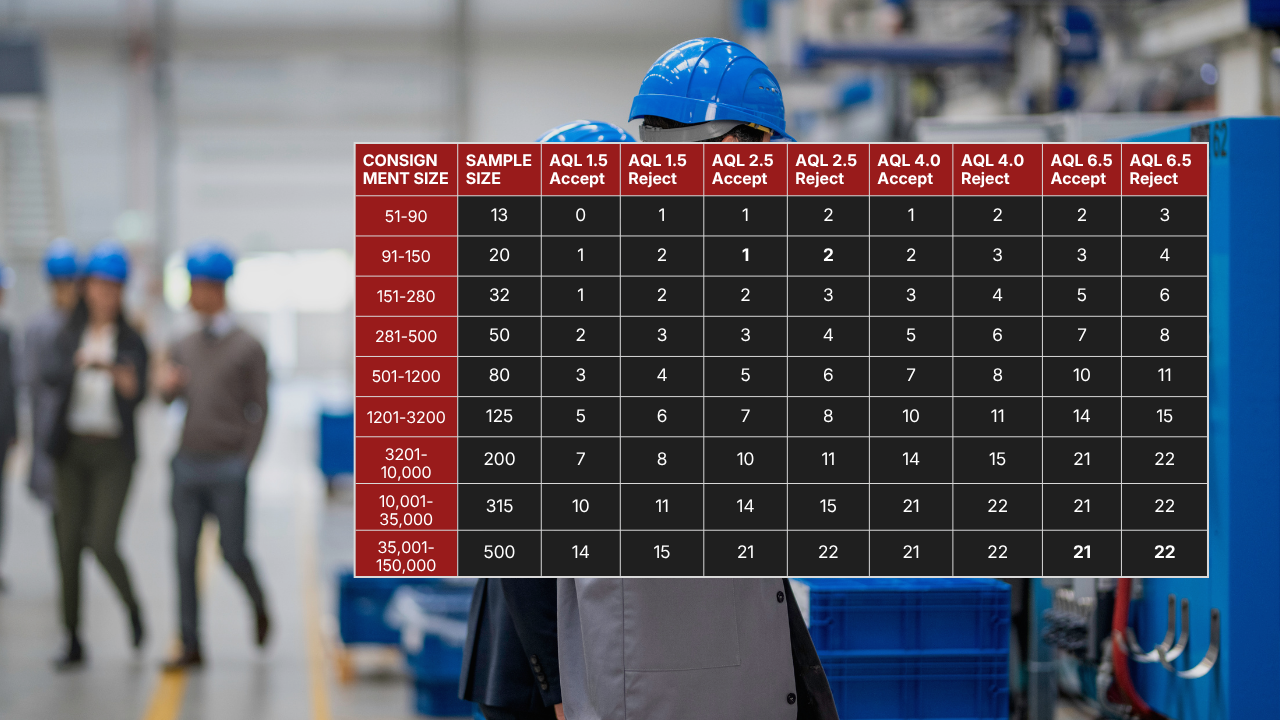
The AQL table looks like a tax form from hell. It isn't. It consists of two parts.
Table 1: Sample Size Code Letters
| Lot Size (Order Qty) | General Inspection Levels | ||
|---|---|---|---|
| I | II (Standard) | III | |
| 1 to 8 | A | A | B |
| 9 to 15 | A | B | C |
| 16 to 25 | B | C | D |
| 26 to 50 | C | D | E |
| 51 to 90 | C | E | F |
| 91 to 150 | D | F | G |
| 151 to 280 | E | G | H |
| 281 to 500 | F | H | J |
| 501 to 1,200 | G | J | K |
| 1,201 to 3,200 | H | K | L |
| 3,201 to 10,000 | J | L | M |
| 10,001 to 35,000 | K | M | N |
| 35,001 to 150,000 | L | N | P |
| 150,001 to 500,000 | M | P | Q |
| 500,001 and over | N | Q | R |
Table 2: Single Sampling Plan for Normal Inspection
| Code Letter |
Sample Size |
Acceptable Quality Limits (AQL) | |||
|---|---|---|---|---|---|
| 0 (Critical) |
1.5 | 2.5 (Major) |
4.0 (Minor) |
||
| Ac | Re | Ac | Re | Ac | Re | Ac | Re | ||
| A | 2 | 0 | 1 | ↓ | ↓ | ↓ |
| B | 3 | 0 | 1 | ↓ | ↓ | ↓ |
| C | 5 | 0 | 1 | ↓ | ↓ | ↓ |
| D | 8 | 0 | 1 | ↓ | ↓ | 0 | 1 |
| E | 13 | 0 | 1 | ↓ | 0 | 1 | 1 | 2 |
| F | 20 | 0 | 1 | ↓ | 1 | 2 | 2 | 3 |
| G | 32 | 0 | 1 | 1 | 2 | 2 | 3 | 3 | 4 |
| H | 50 | 0 | 1 | 2 | 3 | 3 | 4 | 5 | 6 |
| J | 80 | 0 | 1 | 3 | 4 | 5 | 6 | 7 | 8 |
| K | 125 | 0 | 1 | 5 | 6 | 7 | 8 | 10 | 11 |
| L | 200 | 0 | 1 | 7 | 8 | 10 | 11 | 14 | 15 |
| M | 315 | 0 | 1 | 10 | 11 | 14 | 15 | 21 | 22 |
| N | 500 | 0 | 1 | 14 | 15 | 21 | 22 | ↑ |
Note: A down arrow (↓) means use the first sampling plan below the arrow. An up arrow (↑) means use the first sampling plan above the arrow.
Table 1: Sample Size Code Letters
First, you look at your total order quantity (the "Lot Size"). Let’s say you ordered 3,000 pieces. You look at the "General Inspection Levels." Unless you have a very specific reason, you always choose Level II. Follow the row for 3,000 units to the Level II column. You get a letter. Let’s say it’s "K."
Table 2: The Sampling Plan
Now, you take your letter "K" to the second table. This table tells you that for "K," the inspector must pull 125 units at random. Look across the row for your AQL limits.
- For Major (2.5), the table might show: Accept 7 / Reject 8.
- For Minor (4.0), the table might show: Accept 10 / Reject 11.
If the inspector finds 8 major defects, the batch fails. You don't pay. They fix it.
Why Level II?
Level I is for when you trust the factory with your life. You shouldn't. Level III is for high-risk, high-margin electronics where a failure is catastrophic. It’s expensive because the sample size is huge.
Level II is the "Goldilocks" zone. It gives you enough statistical confidence to sue or negotiate without paying for a week-long inspection. It is the industry standard for a reason. Use it.
Weaponizing AQL in Your Purchase Order (PO)
This is where most importers drop the ball. They talk about AQL during the sales process, but they leave it out of the contract. In China, if it isn't on the PO, it doesn't exist.
"Inspection shall be performed according to ISO 2859-1 (AQL), General Inspection Level II. Limits are 0 for Critical, 2.5 for Major, and 4.0 for Minor. A 'Fail' result on the third-party inspection report is grounds for immediate rejection of the lot. The seller shall be responsible for 100% rework and the cost of any subsequent re-inspections."
This clause changes the power dynamic. Suddenly, the factory isn't just trying to ship boxes; they are trying to pass a test. They know that if they fail, the goods sit in the warehouse, and their cash flow dries up.
The "Rework" Trap
Factories hate reworking. They will try to "sort" the defects. This usually means they just move the bad units to the bottom of the boxes. Don't let them. If the inspection fails, you demand a full report on how the rework was conducted. You then send the inspector back in. This costs the factory money. Pain is a powerful quality control tool.
The Psychology of the Factory Manager
Understand this: The manager wants the path of least resistance. If you are "the nice guy" who just wants a good product, you get the leftovers. If you are "the AQL guy" who has a third-party inspector ready and a contract that locks the final payment to a "Pass" report, you get the best workers on the line.
Real-World Defect Definitions: Be Specific
"Major" and "Minor" are still subjective until you define them. Before the inspection, create a "Defect Classification List." For example, for a coffee maker:
- Critical: Any smell of burning plastic.
- Major: Leakage at the base.
- Minor: Scratches under 2mm on the side panel.
Give this list to your inspector. Give it to the factory before they start production. When you do this, you remove the factory's favorite excuse: "We didn't know this was a problem."
The Inspector: Your Only Ally
Never, ever use the factory's "in-house QC." Their paycheck comes from the person who wants to ship the goods. Their loyalty is bought. Hire an independent third-party inspection firm. They are your eyes. They don't care about the factory's schedule. They only care about the AQL table.
An inspection costs between $200 and $300 per man-day. If you are importing $20,000 worth of goods, $300 is cheap insurance. If you think that's expensive, wait until you see the bill for shipping 20 tons of unsellable garbage back to China—or worse, the cost of a product liability lawsuit.
Special Inspection Levels (S-1 to S-4)
Sometimes, Level II isn't enough. Or it's too much. If you are buying $50,000 worth of expensive drones, you might want a "Function Test" on a smaller sample because the test takes two hours per unit. This is where "Special Levels" come in. They allow for smaller samples for destructive or time-consuming tests.
But for the general visual and functional check? Stick to Level II. Don't let the factory talk you into S-level inspections for the whole batch. That's a trick to reduce the sample size so they can hide more junk.
When the Report is "Fail"
This is the moment of truth. The inspector sends you a PDF. It’s red. The factory will call you. They will say: "The inspector was too strict." "These minor defects won't affect sales." "We will give you a $500 discount if you ship now."
Hold the line. If you accept a failed lot once, you have set the new standard. The factory now knows your "real" AQL is much higher than your contract says. Quality will slide further on the next order. The answer is always: "Rework and re-inspect."
Logistics and Timing: The AQL Buffer
You cannot run an AQL-based supply chain with zero time margin. If your ship leaves on Tuesday, don't schedule the inspection for Monday. You need at least a week. This gives the inspector time to write the report, you time to review it, and the factory time to panic—and then fix the mistakes.
The Standard is Your Shield
The "China Quality" problem is rarely about a lack of skill. China can build anything to any standard. The problem is a lack of clear, enforceable boundaries.
AQL provides those boundaries. It turns a subjective argument about "quality" into an objective measurement of "compliance." It moves you from a position of hope to a position of power.
You aren't asking for a favor. You aren't begging for good products. You are enforcing a contract based on internationally recognized AQL inspection standards. If the numbers don't add up, the container doesn't move. That is how you survive twenty years in this game. That is how you protect your brand. Stop looking for perfection and start looking at the table.
The math doesn't lie. Factories do. Choose the math.