

In recent years, an increasing number of independent brand founders and designers have flown directly to Guangzhou, attempting to bypass sourcing agents and connect directly with factories for the "bottom price." However, in the deep waters of cross-border supply chains, invisible traps are everywhere.
For high-end custom apparel—especially the "Relaxed Luxury" oversized t-shirts—the most common and hardest-to-detect trap is fabric short-weight (GSM cheating).
Today, we are going to break down this invisible profit black hole using a real calculation case, and provide you with an essential fabric cost calculation manual for overseas apparel buyers.
1. The Invisible 30 Grams: How It Destroys Your Brand Positioning
Imagine you are building a luxury streetwear brand. Your Tech Pack strictly specifies a 270g/m² (GSM) combed compact spun cotton. This heavyweight 270 GSM fabric is the core element that supports the structured, premium drape of an oversized fit.
You find a factory offering a "highly cost-effective" quote. What you don't know is that to cut costs, the factory actually uses 240g/m² fabric for your bulk production.
A mere 30-gram difference is maybe impossible to detect with the naked eye, but the consequences are disastrous: the garment's structure completely collapses. Shrunk down to 240 GSM, the shirt clings softly to the body. After one wash, it loses its shape, and your carefully crafted "high-end positioning" instantly vanishes and consumers will instantly perceive the garment as cheap.
A severe shortage in GSM often indicates that the factory overstretched the fabric during knitting and finishing to artificially increase the total meterage. Even if the fabric is pre-shrunk, it will almost certainly exceed the strict \le3\% shrinkage limit after washing, causing the garment to severely distort.
2. Let's Do the Math: How Much is the Factory "Stealing"?
Let's run the numbers using a real scenario. Suppose you place a small initial order: 5 styles, 500 pieces each (2,500 pieces total). This requires approximately 3,000 meters of body fabric.
- Target Requirement: 270 g/m²
- Actual Delivery: 240 g/m²
- Weight Deviation Rate: 11.1% (Far exceeding the internationally accepted 5% rejection red line for textiles)
- Stolen Fabric Weight: 3,000m (Length) × 1.5m (Width) × 30g (Difference) ÷ 1000 = 135 kg of fabric.
- Your Direct Financial Loss: 135 kg × ~$6.50/kg = Over $870 USD.
*Note: This calculation only covers the main body fabric. High-end oversized tees use heavier 1x1 or 2x2 ribbing for the collar. If the factory downgrades the premium ribbing too, your actual losses will be significantly higher.
You paid for cotton that never existed. If you scale this up to a 30,000-piece Christmas container order, your hidden loss swallowed by the factory would exceed $10,000 USD on a single run.
3. Why You Need a Real Sourcing Agent
Professional B2B sourcing agents operate on a "Gain-Share" and 100% transparent business model:
- Zero Factory Kickbacks: We use local resources and negotiation leverage to push the factory price down to the true bottom line.
- Commissions from Savings: We only take our service fee from the price difference we save for you.
- Ironclad QC Inspections: We enter the factory with professional expertise and testing equipment to ensure your GSM is exactly your GSM, ensuring tolerance we barginned matching with your price.
"Professional supply chain management is always an investment, never an expense."
4. Appendix: The Ultimate Fabric Cost Calculation Manual
Use this manual for garment costing, factory auditing, QC inspections, and order claims.
4.1 Woven Garment Yield Calculation (Pattern Area Method)
Core Logic: Split all pattern pieces, add seam allowances, sum up for the net pattern area; then divide by the marker efficiency rate to account for cutting waste.
Note: Calculating irregular pieces like sleeves or collars using a simple length × width "bounding box" slightly overestimates the net area. However, it provides an extremely safe and reasonable baseline for cost defense.
Example (Dress):
- Bodice (A): (Half Chest 34cm × 2 + 2cm seam) × 2 (Front/Back) × (Length 20cm + 2cm seam) = 1584 cm²
- Skirt (B): (Hem 120cm + 4cm seam) × (Length 37cm + 5cm hem/seam) = 5084 cm²
- Sleeves (C): (Bicep 32cm + 2cm) × (Sleeve Length 21cm + 4cm) × 2 = 1700 cm²
- Net Area (A+B+C): 8368 cm² = 0.84 m²
Actual Yield per Garment: 0.84 m² ÷ 70% (Efficiency Rate) = 1.20 m² per piece.
Cost Calculation Fix: Beware of short yardage and false widths. If the usable width is 1.05m and the price is $19.15/m, your actual cost is: 1.20 m² ÷ 1.05m × $19.15 = $21.88 per piece.
4.2 Knit Fabric Calculation (Purchased by KG)
Key Point: Knit fabric weight includes paper tubes and empty gaps (tare weight). If you don't deduct this tare weight before calculating, your actual fabric unit price skyrockets.
Formula: Actual Cost per Piece = True Net Fabric Price ($/kg) × GSM (kg/m²) × Single Garment Area (m²).
4.3 Essential Trade Conversions
- Meters per KG: 1000 ÷ [GSM (g/m²) × Width (m)]
- GSM from Linear Weight: GSM (g/m²) = [Linear Weight (lb/yd) × 19530] ÷ Width (inches)
- oz/yd² to g/m²: oz/yd² = g/m² × 0.0295 (Rough estimation: g/m² ÷ 34 ≈ oz/yd²)
4.4 Calculate Your Exact Losses Instantly
Don't guess how much money you are losing to factory tricks. We have built a free, automated tool to do the math for you.
Try Our Free Tool
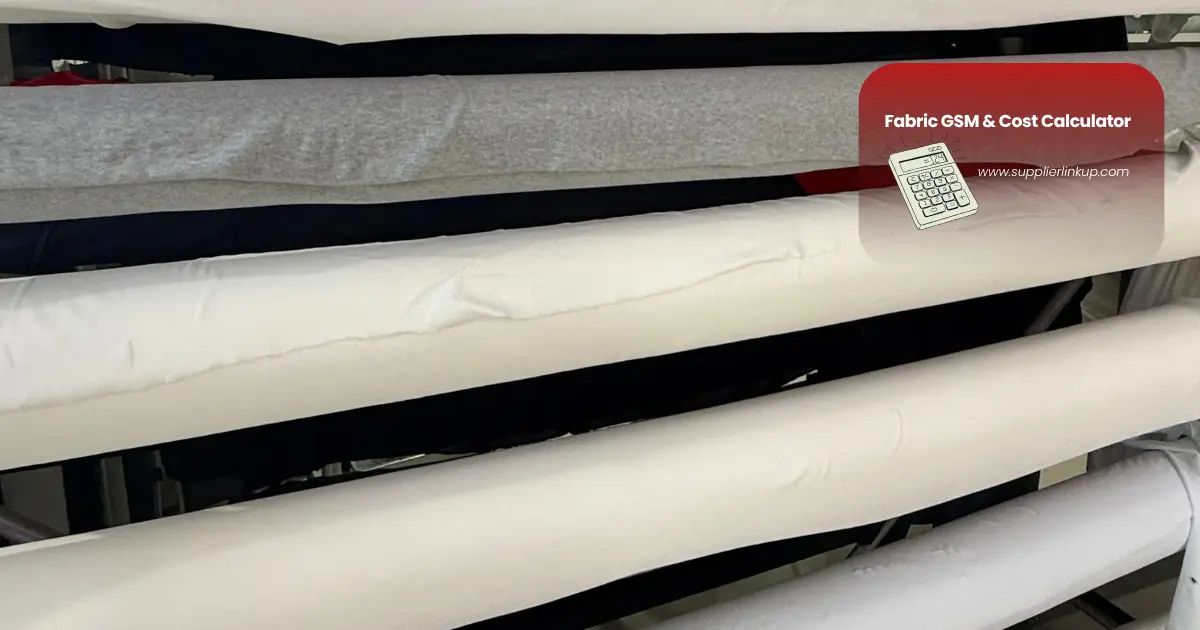
Use our Fabric GSM & Cost Calculator to instantly calculate weight deviation rates, missing fabric weight, and your total financial loss.
4.5 QC & Costing Inspection Checklist
- Finished Weight Mandate: Ensure your Tech Pack explicitly states the target GSM is "Finished Weight". Never accept factory excuses like "the fabric lost weight during enzyme washing or dyeing."
- Test the actual fabric GSM and compare it against the target specs to calculate negative deviations. If negative deviation is > -5% (without special contract terms), it is a breach of contract.
- Measure the actual usable width; check for false width labels.
- Weigh the whole roll, subtract the paper tube weight, and calculate the true net price per kg.
- Check trims against the original sample: buttons, lace, zippers. Ensure no cheap plastic substitutes were used to offset costs.
Frequently Asked Questions
Do I need to find a factory before starting my custom project?
Not at all. Factory vetting and matching is a critical part of our workflow. We audit and select the most capable manufacturer based on your specific engineering requirements—ensuring they have the right machinery and experience for your private mold or custom apparel. Learn more about our comprehensive Product Sourcing services.
Why does fabric GSM sometimes drop after washing even if it passed inspection?
To pass pre-shipment QC, dishonest factories often use temporary "weight-adding" tricks. The fabric passes the scale test on the spot, but the fake weight disappears after delivery. As your sourcing agent, we know exactly how to detect these illusions:
- Chemical Additives & Softeners: Factories add weighting agents to artificially boost GSM. While it adds grams, it makes the fabric prone to dampness, discoloration, and color fading during storage.
- Resin & Starch Coatings: Quick fixes that add weight but make the fabric feel unnaturally stiff—an immediate red flag for our experienced QC inspectors.
- Powder Padding: A highly deceptive trick where the fabric feels normal, but the fake weight washes out immediately upon the first laundry cycle, ruining the garment's structure.
- Pre-Shrinking Manipulation: A hidden mechanical method that alters the fabric's density without changing its appearance, making it extremely hard for amateurs to detect.
We don't just rely on a digital scale. We perform rigorous wash tests and professional texture audits to expose these tricks before your goods ever leave China.
Supplier Linkup: Your Trusted Sourcing Partner
If you want to source products from Supplier Linkup, we act as a trustworthy go-between, making sure both sellers and buyers benefit and trust each other in their agreements.