

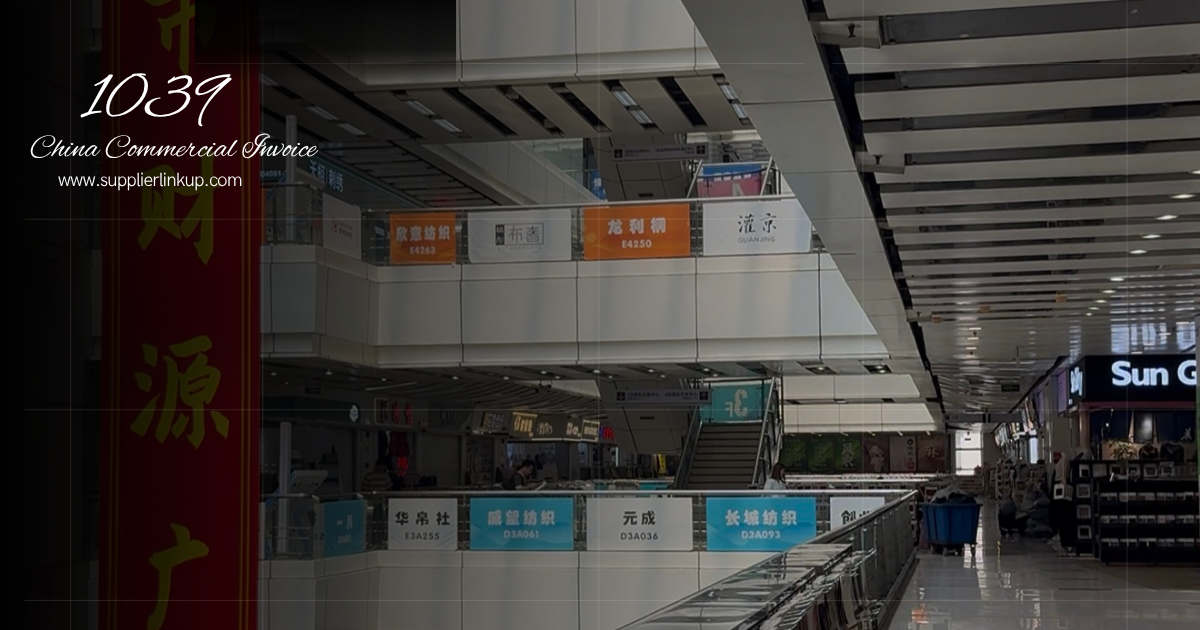
Many overseas buyers love diving deep into China's major wholesale markets (such as Guangzhou's garment and fabric markets, or Yiwu's small commodity markets) to source products. The variety is endless, and the prices are highly competitive. However, when it's time to load the container and ship the goods home, they often hit a critical roadblock: individual vendors in these markets cannot issue the Commercial Invoice required for export.
These small vendors usually lack export qualifications. Furthermore, because your purchases might be scattered across multiple stalls, a vendor won't handle export procedures for just a single roll of fabric. Without a compliant Commercial Invoice, you cannot complete customs clearance in your destination country.
Today, through a real client case, we will uncover the risks behind this issue and share how we, as a professional Sourcing Agent, help clients solve this problem compliantly.
1. Case Study: The Buyer's "Consolidation & Customs Dilemma"
Just last week, a client reached out to us. He had purchased a large quantity of clothing and fabrics from various individual stalls in several wholesale markets in Guangzhou, including Wanxing.
- The Client's Pain Point: The stalls were numerous and highly scattered. These individual businesses only cared about delivering the goods and collecting RMB. They were completely unable to provide an English Commercial Invoice or Packing List.
- The Client's Need: He needed someone to consolidate all these loose goods, load them into a single container, and most importantly—legally and compliantly issue a Commercial Invoice that works for customs clearance in his destination country.
This isn't just happening in Guangzhou. Every day, in Shenzhen Huaqiangbei, Zhejiang Yiwu, and Haining Leather City, hundreds of foreign buyers face the exact same dilemma.
2. High-Frequency FAQ: Why You Shouldn't Fake an Invoice
To save trouble, many buyers new to sourcing in China look for non-compliant "grey" channels. This often brings massive risks:
- Q1: Can I just create a Commercial Invoice myself, or ask my freight forwarder to put down a random Shipper?
A (Extremely Dangerous): Absolutely not. If the Shipper on your invoice doesn't match the actual exporting company declared to Chinese customs, or if there's no real financial transaction record, your goods could face detention if inspected by Chinese customs. In your destination country, a fake invoice can lead to hefty fines or even the confiscation of your goods. - Q2: As long as the freight forwarder gets the goods out, do I not need to worry about China's compliance issues?
A (Wrong): The core of international trade is the "Consistency of Three Flows" (Product Flow, Capital Flow, and Logistics must match). If you pay the stalls in RMB through underground banks and then buy export documents, your supply chain will face devastating consequences once anti-money laundering investigations are involved. - Q3: What is the "1039 Market Purchasing Trade Mode"? Can I handle it myself?
A: 1039 is a tax-exempt, compliant export channel specifically launched by China for small commodity markets. However, it has strict limitations (e.g., a single shipment cannot exceed $150,000 USD, and the business must be registered in designated pilot areas). If you are unfamiliar with the declaration elements, it can easily lead to rejected customs entries or credit downgrades. It must be operated by a professional Chinese agency.
3. Our Solution: How a Sourcing Agent Issues Compliant Invoices & Arranges Exports
As your local supply chain manager in China, we do more than just find products. We ensure your purchasing process is 100% legal and compliant. To solve the headache of consolidating goods from multiple wholesale stalls, we offer two fully compliant operational models:
Solution 1: The 1039 Market Purchasing Trade Mode (Tailored for small-value, multi-category shipments)
If your single container's value is under $150,000 USD, this is the perfect solution.
- No Invoices Needed from Stalls: The 1039 mode is a channel set up by China specifically to solve the "individual businesses lack VAT invoices" problem, operating under a tax-exemption policy.
- We Become Your Legal Shipper: Through the official 1039 online platform, our company compliantly inputs the information of all the scattered stalls you purchased from.
- Issuing Official Commercial Invoices: Acting as a legal Chinese exporter, we issue standard, compliant Commercial Invoices and Packing Lists for you, ensuring smooth customs clearance at your destination.
Solution 2: General Trade "Unified Procurement" Mode (Tailored for high-value orders)
If your goods exceed $150,000 USD or the products aren't within the 1039 pilot scope, we use the compliant General Trade mode:
- Signing a Formal Export Agreement: You don't need to sign contracts with dozens of stalls that don't speak English. You only sign one master export purchasing agreement with us (your Sourcing Agent).
- Compliant Foreign Exchange Settlement: You legally transfer USD/EUR to our corporate bank account. We then use compliant channels to pay the individual stalls in RMB.
- Three-Flow Consistency Guaranteed: Through this process, your capital flow, our export customs declaration (product flow), and the ocean bill of lading (logistics) match perfectly. We rightfully issue the Commercial Invoice for you, bringing your customs inspection risks down to zero.
Not being able to get a Commercial Invoice shouldn't be a stumbling block for expanding your business when sourcing in Chinese wholesale markets. As a professional Sourcing Agent, we help you overcome language, tax, and customs barriers through the compliant 1039 mode or general trade agency models. You just need to focus on picking the best products. Leave the rest—consolidation, quality control, customs declaration, issuing the Commercial Invoice, and international logistics—entirely to us.
Appendix: 2026 Complete List of China's 43 "1039 Market Purchasing Trade" Pilot Zones
To help you understand if your sourcing location qualifies for the 1039 policy, here is the complete list of approved pilot markets across China:
- Batch 1 (Benchmark Pilot): Yiwu International Trade City (Zhejiang)
- Batch 2 (Specific Industry Hubs): Haimen Dieshiqiao Home Textile Market (Jiangsu), Haining Leather City (Zhejiang)
- Batch 3 (Multi-Province Expansion): Guangzhou Huadu Leather City, Hebei Baigou Bags & Cases Market, Linyi Trade City (Shandong), Changsha Gaoqiao Grand Market (Hunan), Chengdu International Trade City, Wuhan Hankoubei International Commodity Trade Center
- Batch 4 (Vertical Industry Hubs): Dongguan Dalang Woolen Market, Foshan Lecong Furniture City, Shantou Bao'ao Toy City, Shenzhen Huanan Raw Materials City, Zhongshan Lihe Lighting Expo Center, Shaoxing Keqiao China Textile City, Huzhou Zhili Children's Wear Market, Taizhou Luqiao Daily Necessities & Plastics Trade Center, Xuchang Hair Products Market, Quanzhou Shishi Garment City, Jinjiang International Shoe & Textile City, Qingdao Jimo Garment Market, Yantai San Zhan Wholesale Market, Yichang Three Gorges Logistics Park
- Batch 5 (Inland Expansion): Liaoning Xiliu Garment City, Anhui Bengbu Zhongheng Trade City, Jiangxi Jingdezhen Ceramic Trade Market, Chongqing Dazu Longshui Hardware Market, Kunming New Luosiwan International Trade City
- Batch 6 (Border & Northern Expansion, 2024-2026): Tianjin Wanglanzhuang Trade City, Tangshan Trade City, Jilin Hunchun Northeast Asia International Commodity City, Heilongjiang Suifenhe Qingyun Market, Yunnan Ruili International Commodity Exchange Market, Inner Mongolia Manzhouli Mangou Center, Xinjiang Alashankou Eurasia Commodity City, Urumqi Frontier Trade Market
Supplier Linkup: Your Trusted Sourcing Partner
If you want to source products from Supplier Linkup, we act as a trustworthy go-between, making sure both sellers and buyers benefit and trust each other in their agreements.