

Between January and August 2025, China's machinery and equipment exports reached a staggering 1.8 trillion RMB, marking a 9.2% year-on-year increase. However, the process of exporting heavy machinery is notoriously complex. From booking vessel space to final delivery, customs clearance is where most buyers stumble. Incorrect documentation, wrong HS codes, or non-compliant packaging can lead to delayed shipments, detained cargo, and hefty fines.
To help you smoothly import your "steel behemoths," we have created this ultimate step-by-step playbook. It covers the entire process from preliminary preparation to final delivery, integrating essential knowledge on customs, tariffs, operational strategies, and pitfalls to avoid.
"If you are planning to source construction machinery from China but aren't sure how to select the right OEM factory, we highly recommend reading our core guide first:
Why Changsha is the World's Capital of Construction Machinery: A Complete Buyer's Sourcing Guide"
Phase 1: Preparation & Compliance Check
All import and export documents are based on the equipment's core data. You must verify the machinery's product name, quantity, specifications, weight, dimensions, destination port, and delivery timeline well in advance.
Nailing the HS Code (The Basis for Tariffs)
The Harmonized System (HS) code is the international standard for product classification. It directly dictates your import duty rates and customs regulatory conditions. Getting this wrong has severe consequences! You can perform a preliminary check using official customs databases based on the equipment's material, function, and application. To be completely safe, consult a third-party classification agency or customs broker, providing a detailed description (e.g., "CNC lathe, spindle speed 2000r/min, used for metal processing"). For highly complex machinery, you can apply for an advance classification ruling from customs to prevent future disputes.
Researching Destination Regulations
Market entry standards for heavy machinery vary drastically from country to country. You must prepare the required certification documents beforehand.
| Destination Region | Core Compliance Requirements |
|---|---|
| European Union (EU) | CE Certification, WEEE Compliance Documentation |
| United States | UL Certification, FCC Electromagnetic Compatibility Standards |
| Southeast Asia (Indonesia/Malaysia) | SNI Certification, IPPC Mark for Wooden Packaging |
| South America (Brazil/Argentina) | Import License (INMETRO Certification), Documentation in Spanish |
Phase 2: Packaging & Securing Standards
Ocean freight environments are harsh. Proper packaging and lashing directly determine whether your equipment arrives in one piece.
- Heavy Equipment Packaging: Must utilize steel frames or fumigation-free wooden crates. The interior should be padded with foam or air bubble wrap for shock absorption, with a reinforced, moisture-proof base.
- Anti-Rust & Moisture Prevention: Metal equipment is highly susceptible to rust during long ocean voyages (typically 25-40 days). It requires anti-rust oil coatings, Volatile Corrosion Inhibitor (VCI) film (like wrapping the machine in industrial cling wrap), or vacuum sealing.
- Fluids & Batteries: Equipment containing hydraulic oil or batteries must be sealed separately and accompanied by an MSDS (Material Safety Data Sheet).
- Wooden Packaging Regulations: If solid wood (e.g., pine, poplar) is used for pallets or crates, it MUST be fumigated by an IPPC-certified agency to kill pests, and the exterior must bear the hexagonal "IPPC mark". Otherwise, destination customs will demand expensive local fumigation, cause massive delays, or even order the cargo to be destroyed.
- Clear Markings: Outer packaging must clearly display the product name, gross weight, net weight, center of gravity, forklift lifting points, and bold warning labels like "Keep Dry," "This Way Up," and "Fragile."
- Internal Securing: Movable internal components of the machinery must be firmly locked in place to prevent structural damage from transit vibrations.
Phase 3: Choosing the Right Shipping Method
For large machinery, your freight forwarder first needs the exact length, width, height, and unit weight. This data dictates the suitable shipping method and the final freight cost.
| Shipping Method | Best Scenarios & Equipment Features |
|---|---|
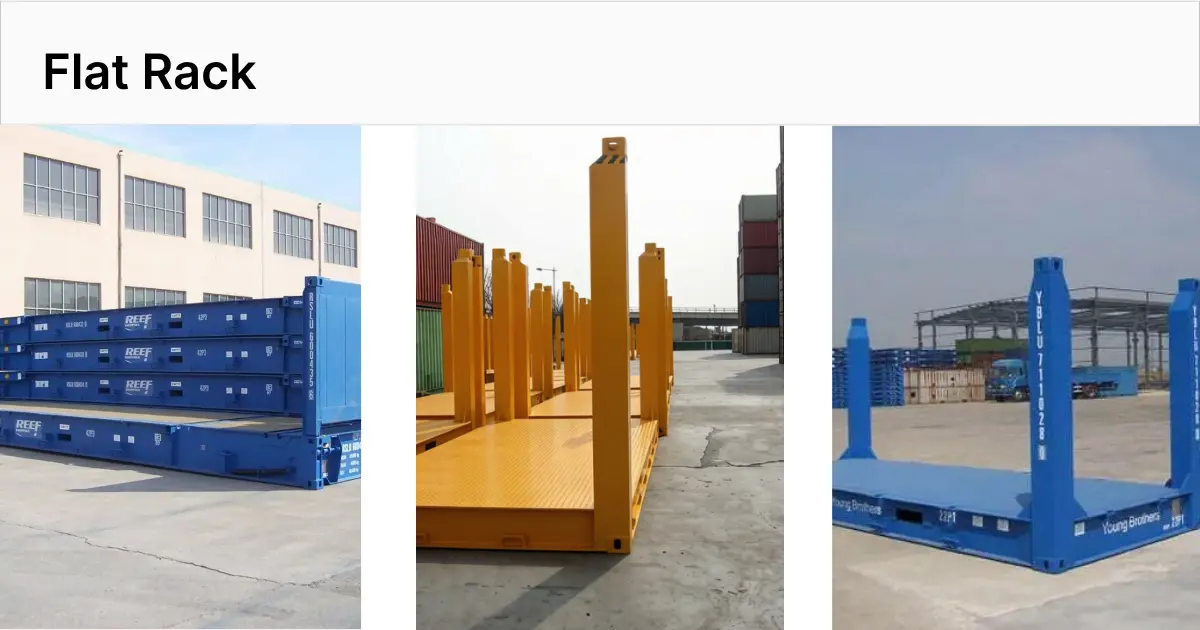
| Flat Rack (FR) Container | Lacks a roof and side walls, making it ideal for over-width or over-height cargo. Can carry equipment up to 14m long, 3m wide, 3m high, weighing up to 30 tons. Most industrial equipment exported to Europe uses this method. |
| Open Top (OT) Container | The roof can be opened for easy overhead crane loading. Perfect for over-height equipment that still maintains a relatively standard rectangular shape. |
| Breakbulk Vessel | Mandatory for massive, indivisible equipment exceeding 30 tons or extreme dimensions that cannot fit into any container format. |
Confirming Port Handling Capabilities
Not all ports are equipped to handle heavy-lift cargo. Before booking, you must verify the maximum lifting capacity of both the port of loading and discharge, the availability of Ro-Ro terminals, whether heavy-lift vessels can berth, adequate water depth, and any tidal restrictions.
Phase 4: The Biggest Pitfall—Destination Unloading
Many logistical disasters don't happen at sea; they happen when the cargo reaches the client's factory. For instance, a 5-ton machine arrives, but the facility lacks a heavy-duty forklift, or the machine is too tall for the factory doors. This leads to emergency (and wildly expensive) rentals of special cranes and severely delays the project.
To ensure smooth delivery, always confirm the following site conditions with the receiver before shipment:
- Exact address conditions and surrounding road accessibility.
- Maximum height and width clearances of the factory entrances.
- Designated unloading zones.
- Availability of on-site lifting and hoisting equipment.
Real-World Case Studies
Case 1: Crane Exported to Vietnam (Standard Equipment Clearance)
- Commodity: Crane (1 Unit)
- Route: China to Vietnam (Ocean Freight)
- Tax Situation: China Export Duty 0%, Tax Rebate 13%; Vietnam Import Duty 0%, VAT 8%.
- Declaration Elements: Brand type, export preference status, intended use, functionality, brand name (Chinese/Foreign), model, GTIN, CAS, etc.
- Workflow: Factory provides packing list & confirms HS code → Verify Vietnam import standards → Book vessel space → Factory pickup & container stuffing → Export inspection & customs declaration → Ocean transit → Vietnam customs clearance & tax payment → Final delivery → Apply for synchronization appraisal.
Case 2: Oil-Immersed Transformer (Heavy-Lift Breakbulk)
- Specialized Booking: Transformers are classified as major project cargo. We submitted equipment blueprints, lifting point instructions, and lashing plans to the shipowner, securing space on a breakbulk vessel at a port equipped for heavy cargo.
- Factory Lashing: Installed solid wood load-bearing skids with IPPC fumigated pallets at the base. The unit was rigidly secured using steel wire ropes and turnbuckles. Oil ports were strictly sealed and waterproofed to prevent leakage at sea.
- Port Loading: A professional rigging crew lifted the cargo according to the center of gravity, securing it to the breakbulk vessel deck to ensure movement remained under 5cm during transit. The entire process was recorded on video as proof of liability.
- Customs Paperwork: Filed under HS code 8504. Included fumigation certificates for the wood, a Certificate of Origin (CO) to reduce European tariffs, and project equipment access permits required by specific African nations.
Essential Customs Clearance Documents
While destination country regulations vary, exporting standard mechanical equipment generally requires a complete set of these core documents:
- 1. Certificate of Origin (CO)
- 2. Import/Export License (from the shipper)
- 3. Customs Declaration Elements
- 4. Original Product Manual / Specifications
- 5. Destination Country Import License (if applicable)
- 6. Clear photos of the equipment exterior and Nameplate
- 7. Packing List (PL)
- 8. Commercial Invoice (CI)
- 9. Sales Contract (SC)
- 10. Bill of Lading (B/L)
Supplier Linkup: Your Trusted Sourcing Partner
If you want to source products from Supplier Linkup, we act as a trustworthy go-between, making sure both sellers and buyers benefit and trust each other in their agreements.