
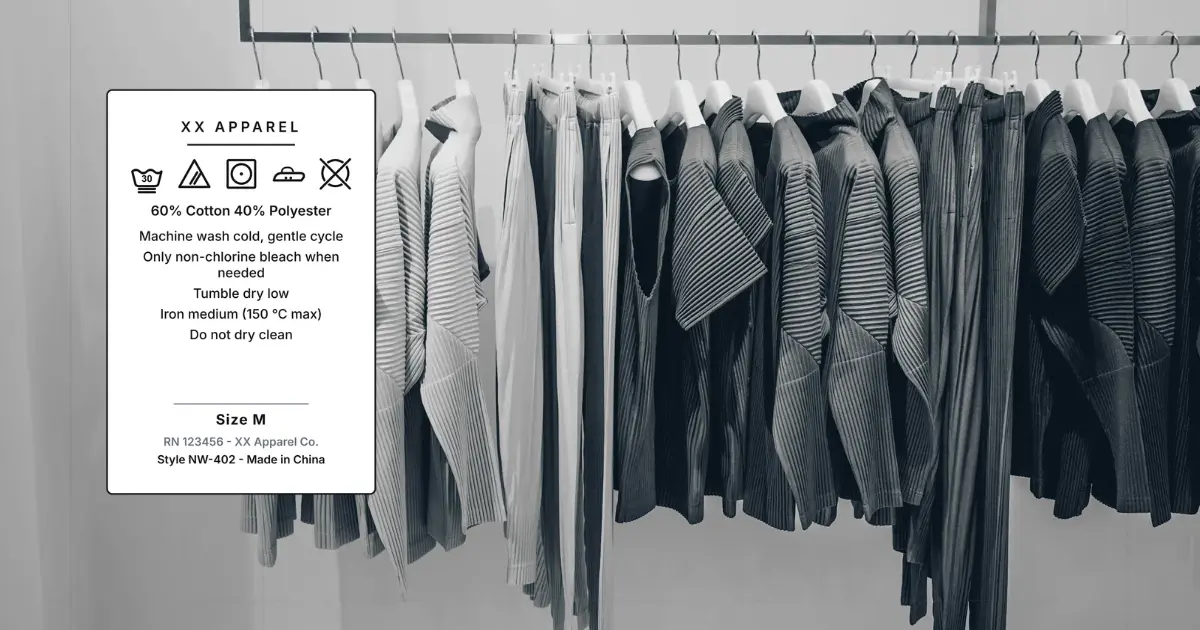
When sourcing apparel from Chinese factories for Western markets, leaving care label formatting up to the supplier is one of the fastest ways to trigger customs holds, retail compliance rejections, or unintended brand exposure. To lock in accurate artwork for your tech packs before sampling begins, start with these free online care label generators built for North American and European standards:
- Adstronaut Care Label Generator (adstronaut.net/free-tools/care-label-generator): Best all-in-one generator for switching between US and EU/UK formats, automatically sorting fiber percentages and outputting print-ready SVG and PNG label files.
- PinFlow Care Label Generator (getpinflow.com/tools/care-label-generator): Free, no-signup template maker supporting ISO 3758 care symbols, bilingual EU layouts, FTC RN numbers, and country-of-origin formatting.
Why Overseas Brands Must Control Care Labels—And Consider Decoupled Branding
Controlling your care labels and branded trims is not just a formatting formality; it protects both your customs clearance and your intellectual property in two critical ways:
- Preventing Labelling Compliance Errors: Chinese garment factories are built for manufacturing speed, not Western retail compliance law. Without a verified, 1:1 vector file in your tech pack, suppliers often default to domestic Chinese labeling layouts—which include mandatory national standard codes irrelevant to Western customs—or piece together translated care text that violates US and European regulations.
- Protecting Brand IP and Supply Chain Confidentiality: Even when a factory signs an airtight NNN (Non-Disclosure, Non-Use, Non-Circumvention) agreement, large factory floors have hundreds of workers and daily foot traffic from visiting buyers. A single smartphone photo of a woven neck label, care tag, or branded hangtag on a sewing line can leak unreleased collections or reveal your manufacturer to competitors.
"For niche, high-margin brands, the safest strategy is decoupled production: let the main factory focus purely on high-efficiency cut-and-sew assembly without branded trims, then route the finished garments to an independent, closed-door finishing studio to apply custom woven labels, care tags, hangtags, final AQL inspection, and retail packaging."
Choosing the Right Free Tool for Your Target Market
Both tech-pack tools solve a slightly different step in your pre-production workflow:
- For Multi-Market Brands (US + Europe): Adstronaut is the most practical starting point because it lets you toggle between US and EU/UK rule sets. When you enter a blend—such as 80% Cotton and 20% Polyester—it automatically orders the fibers from highest to lowest percentage and suggests safe wash symbols based on the most delicate fiber in the garment.
- For Fast Tech Pack Mockups with RN Numbers & Size Runs: PinFlow requires no account creation and lets you plug in your U.S. Federal Trade Commission (FTC) Registered Identification Number (RN), country of origin, and ISO 3758 care symbols directly into standard woven or printed label templates, with a bulk-size sheet export for S–XL runs.
- For Custom Branded Layouts in Adobe Illustrator: Once you generate the compliant fiber order and care sequence from either tool above, download the clean SVG file so your designer—or your sourcing team—can integrate the symbols into your custom brand trim package without risking manual transcription errors.
Key Compliance Differences: Americas vs. Europe & UK
Before exporting your label file and sending it to your trim supplier in China, verify that your layout matches the legal rules of the country where the garments will be sold:
| Compliance Requirement | United States (FTC 16 CFR Part 423) | Canada (Textile Labelling Act) | European Union (Reg. 1007/2011) & UK |
|---|---|---|---|
| Care Instructions | Written English care instructions are mandatory; symbols alone are not sufficient without an approved exemption. | Symbols or bilingual text; Canadian care symbols use a distinct color/shape standard if used without text. | ISO 3758 care symbols are standard; written care instructions are optional in most member states unless specialized care is needed. |
| Fiber Naming Rules | Must use FTC generic fiber names (e.g., Spandex, Rayon) in descending order by weight. | Must use statutory generic fiber names in descending order by weight. | Must use official EU Annex I fiber names (e.g., Elastane, Viscose) in descending order by weight. |
| Mandatory Languages | English. | English and French (bilingual required for fiber content and origin). | Official language(s) of every EU member state where the product is sold (e.g., French in France, German in Germany). |
| Origin & Company ID | Made in China + Company Name or FTC RN Number are strictly mandatory. |
Made in China / Fabriqué en Chine + Canadian dealer name/address or CA Number. |
Origin is not required under Regulation 1007/2011, though EU General Product Safety Regulation (GPSR) requires EU responsible person/importer contact details. |
4 Critical Checks Before Approving Bulk Trims in China
Even with a clean vector file exported from an online generator, always verify these four regulatory checkpoints before authorizing bulk label printing:
- Back Up Care Instructions with Lab Testing: Under the U.S. FTC Care Labeling Rule, brands must have a "reasonable basis"—such as fabric test results—proving that the garment will not be damaged when cleaned according to the label. Never default to "Dry Clean Only" on a washable cotton or polyester garment just to avoid testing; the FTC explicitly prohibits unsubstantiated dry-clean-only labels.
- Confirm GINETEX Trademark Licensing in Europe: The five standard laundry symbols (washtub, triangle, square, iron, circle) are registered trademarks owned by GINETEX across most European countries. While free generators help you build tech pack mockups, brands selling commercially at scale in Europe should confirm that their brand or retail partner holds valid GINETEX authorization before bulk printing.
- Declare Animal-Derived Trims for the EU: If your garment uses leather logo patches, horn or shell buttons, wool, or down/feather insulation, EU Regulation (EU) No 1007/2011 requires the explicit disclosure "Contains non-textile parts of animal origin" translated into the local market language.
- Add Destination-Specific Eco and Filling Tags: If you are shipping to France, French AGEC environmental law requires the Triman recycling logo and sorting instructions on apparel packaging or labels. If you are exporting down jackets or insulated outerwear to the United States, check state-level Law Label registration rules for stuffed and padded articles.
Getting your care label artwork right during the sampling stage saves weeks of costly trim re-orders and prevents port clearance delays once bulk production finishes. If you are preparing tech packs for Chinese garment manufacturers and want hands-on support verifying fabric compositions, separating branded trim sourcing from bulk assembly, or handling private finishing and quality control before shipment, reach out to our sourcing team before your next production run.
Supplier Linkup: Your Trusted Sourcing Partner
If you want to source products from Supplier Linkup, we act as a trustworthy go-between, making sure both sellers and buyers benefit and trust each other in their agreements.