

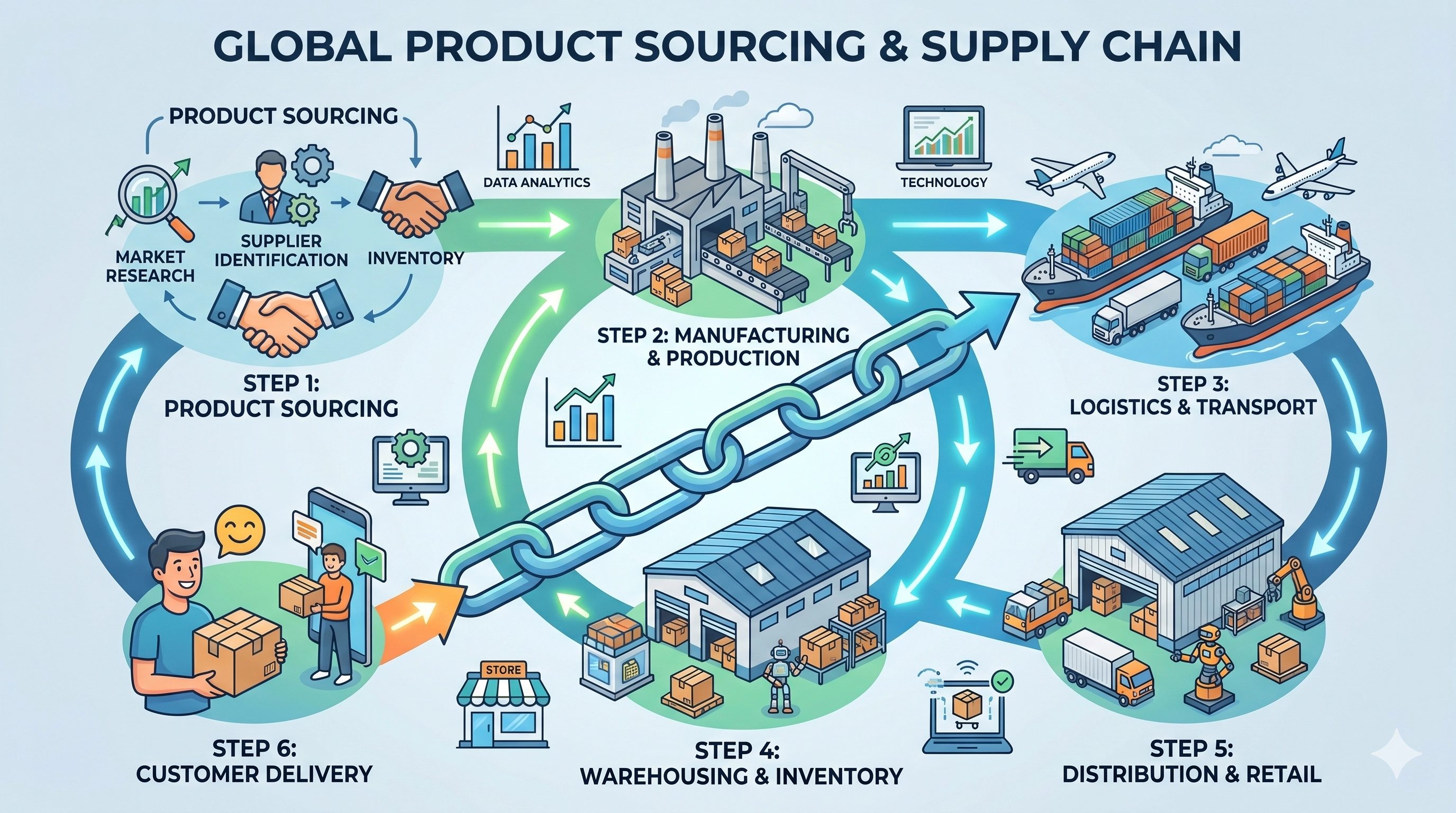
The leap from a novice importer to a true supply chain director is defined by anticipation. The ultimate goal is not simply to "buy cheap," but to build a resilient and predictable logistics infrastructure that protects your margins.
Here is the definitive operating manual for managing your international supply chain in the big leagues. When a company searches for a professional product sourcing service, delegating this exact level of operational complexity is what they are paying for.
1. The Metric That Matters: Total Landed Cost
The deadliest mistake is believing that if you buy for $1 and sell for $3, you are making money. The factory's FOB price is only the beginning of the equation.
The question you must ask yourself is not "How much does it cost at the factory?", but "How much does this product cost sitting in my warehouse and ready to sell?".
To calculate the Total Landed Cost (TLC), you must systematically add:
- Product FOB price.
- International sea or air freight.
- Cargo insurance.
- Import duties.
- Customs clearance (customs broker fees).
- Import VAT.
- Local inland transportation (from the port to your warehouse).
- Invisible operating costs (AQL inspections, audits, sample shipping).
2. Financial Engineering and Currency Management
He who holds the money holds the power, but moving capital across continents carries macroeconomic risks that you must shield against.
Payments and Security
Never pay 100% upfront. The standard structure is a 30% initial deposit and 70% after approving the pre-shipment inspection. For very large transactions, use a Letter of Credit (L/C). The bank holds the money and only pays if the factory presents flawless shipping documents. This significantly reduces the risk (although it must be accompanied by a physical inspection, since the documents can be correct but the merchandise not).
Currency Risk (Foreign Exchange)
Factories operate internally in their local currency (e.g., RMB), but quote you in USD.
- Fluctuations: If the USD loses value against the local currency between your quote and manufacturing, the factory may request a price review, renegotiate conditions, or seek cost alternatives to maintain their margins.
- Hedging: For high volumes, sign fixed-price agreements with review clauses (if the currency fluctuates more than 3%) or use currency hedging insurance with your bank.
3. Regulatory Compliance: Your Legal Responsibility
A container blocked at customs due to a lack of certificates is dead money. Depending on your market, you will need to comply with strict regulations (CE, RoHS, REACH, FCC, FDA, UKCA).
"Importer's Golden Rule: In the eyes of your country's law, the ultimate party responsible for ensuring the product is safe and compliant with regulations is you, not the factory."
Documentary Verification
Do not accept a PDF as sufficient proof. Always verify that the test report exactly matches the model, reference, and manufacturer of the product you are going to import. Confirm the authenticity of the document directly in the database of the issuing international laboratory (such as SGS or TÜV).
4. Supplier Scorecard (KPIs)
What is not measured is not controlled. Evaluate your factories quarterly using cold, objective performance metrics.
| Indicator (KPI) | Professional Target | Action if Not Met |
|---|---|---|
| On-Time Delivery | > 95% | Apply financial penalties per contract. |
| Defect Rate | < 1% | Demand free replacement or a discount on the next batch. |
| CAPA Implementation | 100% | Verify if the factory audited the root cause and corrected their processes to prevent the failure from recurring. |
| Response Time | < 24 hours | Escalate to the account manager or activate contingency suppliers. |
| Price Variation | Controlled | Renegotiate terms or volume. |
5. Inventory Management: The Bridge to Sales
Going out of stock (stockout) stops your revenue dead in its tracks while your fixed costs keep running. To avoid this, mentally divide your inventory:
- Operating Stock: The merchandise you need to cover your expected daily sales.
- Safety Stock: An untouchable inventory designed exclusively to absorb unexpected sales spikes or shipping delays.
- Reorder Point: The exact inventory level at which you must transfer the 30% deposit to your factory to start the next batch, considering production and transit times.
6. Purchasing Strategy and Scalability
As the business grows, your role shifts from a simple transaction to strategic management. To build a truly resilient supply chain:
- Diversify suppliers: Never depend on a single manufacturer. Always maintain active relationships with secondary suppliers.
- Diversify countries (China + 1): Reduce geographical dependence by exploring alternatives in Vietnam, India, Mexico, or Eastern Europe to mitigate tariff or geopolitical risks.
- Negotiate annual contracts: Move from negotiating order by order to closing annual volume agreements, stabilizing your cash flow and your costs.
- Lock in raw material prices: If your product relies on steel, cotton, or polymers, negotiate agreements to fix the base material cost when the market is down.
- Reserve production capacity: Stay ahead by securing space on the assembly lines months in advance to protect your stock before peak seasons or critical holidays (like Q4 or Chinese New Year).